About the district

A history held
in its streets.

Aba Shawl is one of Asmara’s oldest districts. Its dense urban fabric, colonial history, and strong neighborhood ties form an essential part of the city’s identity.

01 / Origins

How it began

Before the Italian occupation, the hill where Abashawl now stands was known locally as Gnbar Abba Awts—a thickly forested, uninhabited wilderness of cypress trees and thorny bushes. The first settlements began as Italian colonial forces arrived.

A feudal lord named Kentiba Desta from Tse’Azega brought his family and troops to camp at the hilltop. He was assisted by a vassal from Tigrai whose horse—and battle cry—was “Abba Shawl.” The name remained as they became familiar figures in the growing community.
02 / Colonial era

A city divided

Under Italian colonial rule, Asmara was divided along racial lines. Abashawl became part of the indigenous zone, while the city center—Campo Cintato—was reserved for Europeans. Many Eritreans displaced from the European zone were forced into Abashawl, making it one of the city’s most densely populated areas.

Despite a colonial policy of exclusion, the community preserved its identity. Eritreans of many ethnic groups and religions lived side by side, fostering a culture of inclusion and tolerance that became a hallmark of Asmara.

03 / Community life

A culture of sharing

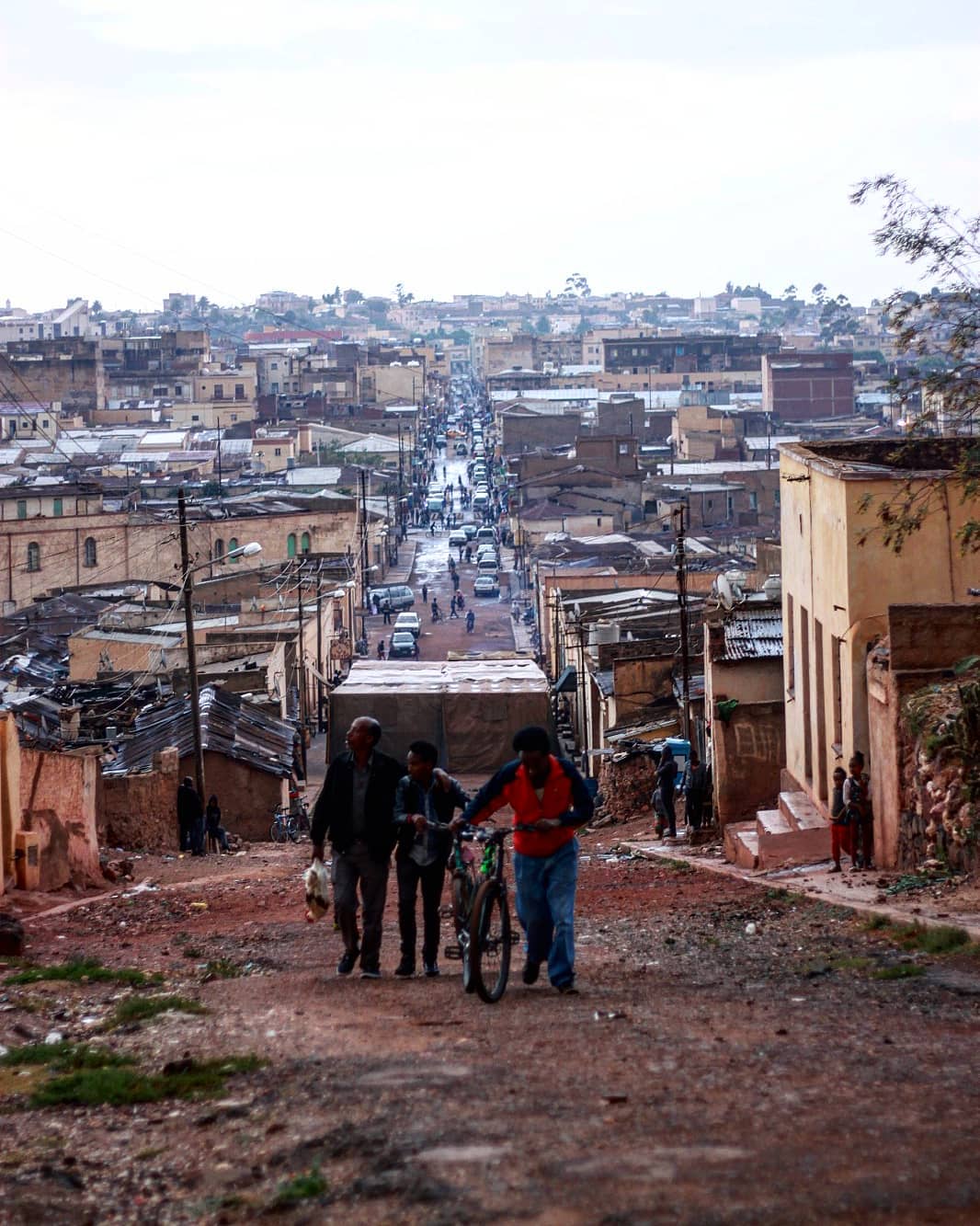
Residents walking up an unpaved street surrounded by closely built homes in Abashawl
The neighborhoodEveryday life

Homes were closely built, pathways were narrow, and privacy was scarce. That proximity also produced a deep sense of community: neighbors shared material goods and personal stories, watched over one another, and often resolved disputes locally through arbitration.

Ekub self-help groups and religious gatherings offered space for discussion and mutual support. Chiefs, judges, colonial officers, and less fortunate residents mixed freely, reinforcing a tradition of openness and solidarity.

04 / Living heritage

Today and tomorrow

Abashawl and Campo Cintato are inseparable parts of Asmara’s identity: the city’s architectural beauty would lose its soul without Abashawl’s indigenous heritage. In the 1960s, plans to demolish and rebuild the district met fierce resistance.

Today, narrow alleys still wind through the hillside, carrying memory forward while the community continues to shape the city. Modernizing without losing this social and cultural balance remains an essential challenge.

Reference

Information adapted from Shabait.com ↗, submitted to the Asmara Heritage Project in 2015.